It is a frustrating but common scenario like you are in the middle of a Zoom call or cooking dinner when suddenly, the lights go out and the aircon cuts off. In Singapore’s high-density HDB flats and condos, a power trip is rarely just a random glitch; it is a safety feature of your electrical system working exactly as it should to prevent a fire. Usually, the trip happens because the system detected a surge or a leakage that could damage your appliances or, worse, cause an electrical shock.
Instead of panicking in the dark, you need a clear plan to find the source of the problem. This guide will help you understand why your power tripped and show you exactly what to check first so you can get your home back up and running safely.
Immediate Troubleshooting and Steps When Your Power Trips
When the power cuts out, your first destination should be the Distribution Board (DB) box, usually located near the entrance or in the kitchen of most Singapore homes. Before you touch anything, ensure your hands are dry. Open the cover and look for any switches that have flipped downward.
The DB box contains the Main Switch, the Residual Current Circuit Breaker (RCCB), and several Miniature Circuit Breakers (MCBs). If the RCCB is down, it means there is a current leakage. If only one MCB is down, the issue is localized to a specific room or a high-power appliance like your water heater. If you smell burning plastic or see smoke coming from the box, do not attempt to reset the switches. In such cases, it is vital to contact a professional handyman service in Singapore immediately to avoid a hazardous situation.
5 Common Causes of Power Trips in Singapore HDBs & Condos?
Understanding what causes a power trip at home helps you prevent it from happening again. In Singapore, the most common reasons involve how we use our modern electronics and the local environment.
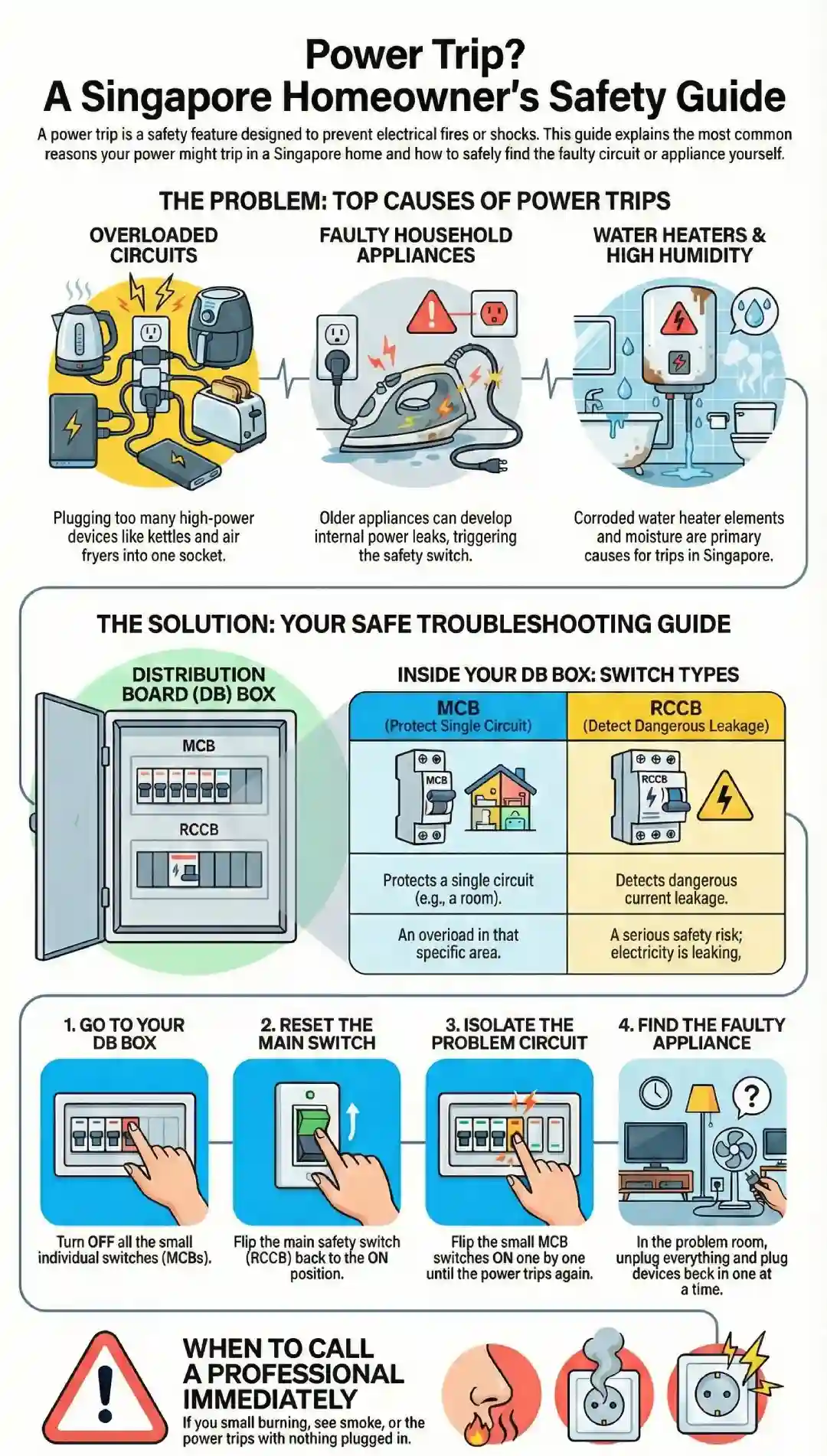
Overloaded Circuits
This common issue strikes when you plug too many high-wattage devices into a single power point or circuit. Everyday examples include running a portable aircon, vacuum cleaner, and electric kettle all at once on the same line. The combined load exceeds the circuit’s safe capacity, causing overheating and an automatic trip to prevent fires or damage.
Faulty Household Appliances
Older appliances often develop internal “power leaks” from worn-out parts. If the motor in your fridge or washing machine starts failing, it draws far more current than normal. The RCCB detects this imbalance and trips immediately to protect you from potential electric shocks or further breakdowns.
Ground Faults and Humidity
Singapore’s high humidity acts as a silent enemy, allowing moisture to seep into outdoor balcony lights, poorly sealed kitchen sockets, or damp areas. This creates a “leak” of electricity directly to the ground wire. Even small amounts of water can trigger the safety mechanism, tripping the breaker to avoid dangerous shocks.
Short Circuits
A short circuit happens when a “live” wire accidentally touches a “neutral” wire, creating a massive surge. Common causes include loose connections inside sockets, frayed cords, or pests like cockroaches and rodents chewing through wires hidden in your walls. The sudden high current flow trips the breaker in seconds to prevent fires.
Water Heater Issues
Water heaters are a top trip cause because they handle both high current and water at the same time. Over years of use, the heating element can corrode or crack, allowing electricity to contact the water inside. This ground fault trips the breaker instantly, safeguarding against electrocution risks.
Comparing Common Electrical Components in Your DB Box
| Component | Full Name | Primary Function | What a Trip Means |
| MCB | Miniature Circuit Breaker | Protects individual circuits (e.g., Bedroom 1, Kitchen). | Overload or a short circuit in that specific area. |
| RCCB / ELCB | Residual Current Circuit Breaker | Detects current leakage to the ground. | Safety risk; electricity is “leaking” where it shouldn’t. |
| Main Switch | Main Supply Switch | Controls the total power entering the house. | Serious fault or total supply surge from the grid. |
Step-by-Step Guide: How to Troubleshoot a Power Trip Yourself
You can often find the “why power trip” answer yourself by using the isolation method. First, go to your DB box and turn off all the individual MCB switches. Next, flip the main RCCB switch back to the “On” position. One by one, flip the MCB switches back up. When you flip the switch that corresponds to the faulty circuit, the RCCB will trip and fall back down again. Now you know which part of the house has the problem.
Go to that room, unplug every single appliance, and reset the DB box. Plug the appliances back in one at a time. The moment the power trips again, you have found your faulty device. If you find that the trip happens even when nothing is plugged in, the problem is likely in the hidden wall wiring, and you should take our electrical services for a professional inspection.
Beyond the Trip: Risks of Ignoring Frequent Electrical Failures
While it might be tempting to simply flip the switch back up every time a power trip happens, ignoring a recurring issue is dangerous. A power trip is a warning sign that your electrical system is under stress. If a circuit breaker trips frequently, it can lead to “arc faults,” where electricity jumps across gaps in damaged wiring. This creates intense heat that can melt insulation and start a fire inside your walls before you even see smoke.
Furthermore, constant tripping causes sudden power surges that can fry the sensitive motherboards of your expensive smart TVs, computers, and gaming consoles. If you find yourself resetting your DB box more than once a week, there is a deep-seated issue that needs more than just a quick reset. If your power issues are accompanied by flickering lights, choose the right handyman in Singapore to ensure you get a qualified professional to look at your wiring.
Preventive Maintenance for a Trip-Free Home
The best way to handle a power trip in HDB flats is to prevent it through regular maintenance and smart usage habits. You should practice load balancing, which means not plugging your microwave, air fryer, and electric oven into the same power strip. In older Singapore estates, the electrical load capacity might be lower than in modern BTOs, making load balancing even more critical. Another essential tip is the “Monthly Test.” Every RCCB has a small button marked with a ‘T’ or the word ‘Test’. You should press this once a month; it should instantly trip the power. This confirms the safety mechanism is not “stuck” and will actually protect you during a real leakage. If you are moving into a resale flat, ensure your electrical points and DB box are up to current safety standards.
Professional vs. DIY
There is a limit to what a homeowner should do regarding electrical repairs. If you have performed the unplug test and the power still trips even with no appliances connected, the fault lies within the fixed wiring or the DB box itself. These components carry high voltage and require specialized tools to test safely. You should call for professional help if you see charred marks around your sockets, hear a buzzing sound from the walls, or if the main switch feels warm to the touch.
In Singapore, certain electrical works must be performed by an EMA-licensed technician to remain compliant with housing regulations and insurance policies. Our team provides reliable handyman services to help diagnose these hidden faults before they turn into expensive renovation disasters.In Singapore, specific electrical repairs must be performed by an EMA licensed electrical worker to ensure your home remains compliant with national safety standards.
Common High-Consumption Appliances in Singapore Homes
| Appliance Type | Average Wattage | R isk Level for Power Trip | Recommended Action |
| Instant Water Heater | 3000W – 4500W | High | Use a dedicated 15A or 20A circuit. |
| Air Conditioner | 900W – 2500W | Medium | Perform regular aircon service to prevent motor strain. |
| Electric Kettle | 2000W – 2400W | Medium | Do not share a socket with other high-heat tools. |
| Induction Hob | 1500W – 3000W | High | Ensure wiring is rated for high-current loads. |
Frequently Asked Questions
Why does my power trip when it rains?
In Singapore, heavy tropical rain often causes power trips because moisture enters external electrical components. If you have lights on your balcony, garden, or an outdoor compressor for your aircon, rainwater can seep into the casings and create a path between the live wire and the ground. This triggers the RCCB instantly to prevent electrocution.
Why does my water heater keep tripping the circuit breaker?
The water heater is often the most common power trip reason in local households. Inside the tank or the instant heater unit, there is a copper heating element. Over time, mineral deposits from the water cause the element to corrode and crack. When water touches the internal electrical filament, a ground fault occurs. If your heater trips the power the moment you turn on the switch, the heating element has likely failed and the unit needs replacement.
Can a faulty lightbulb cause a whole house power trip?
Yes, it is possible. When a lightbulb “blows,” the filament can sometimes snap in a way that creates a momentary short circuit. While the individual MCB for that room should handle it, the sudden surge can sometimes be enough to trigger the more sensitive RCCB, plunging the entire house into darkness.
What is the difference between an MCB and an RCCB trip?
An MCB (Miniature Circuit Breaker) trips when there is too much “load” or a short circuit, basically, too much electricity is trying to flow through a wire that cannot handle it. An RCCB (Residual Current Circuit Breaker) trips when it detects that electricity is “leaking” out of the system, such as through a person or into water.
Conclusion: Ensuring a Resilient Power Supply for Your Family
Dealing with a power trip in Singapore is a part of home ownership that requires both patience and a basic understanding of your DB box. By following the isolation method and performing regular checks on your high-wattage appliances, you can resolve most minor issues without stress. Remember that your circuit breakers are there to protect your life and your property; they are the first line of defense against electrical fires and shocks. Never force a switch to stay in the “On” position if it keeps flipping back down, as this is a clear sign of a hard fault that needs expert repair.
For long-term peace of mind, keep a record of when your home was last rewired and stay on top of appliance maintenance. If you are ever unsure about the safety of your sockets or the health of your wiring, don’t hesitate to reach out to our team at Handyman Services Singapore. Whether you need help with TV mounting in Singapore or a complete electrical diagnostic, we are here to ensure your home remains safe and powered up.