Deciding between an accent wall or painting a whole room is a common dilemma for Singapore homeowners looking to refresh their space. Whether you live in a compact HDB flat or a spacious condo, the way you apply color can completely change how large or cozy your home feels. Many people worry that a bold accent wall might look dated, while others fear that painting an entire room in a dark shade will make it feel like a cave. The truth is that both strategies have a specific purpose. Choosing the right one depends on your room’s natural light, your furniture, and the mood you want to create. This guide will break down the differences so you can stop guessing and start painting with confidence.
Accent Wall vs. Whole Room Paint
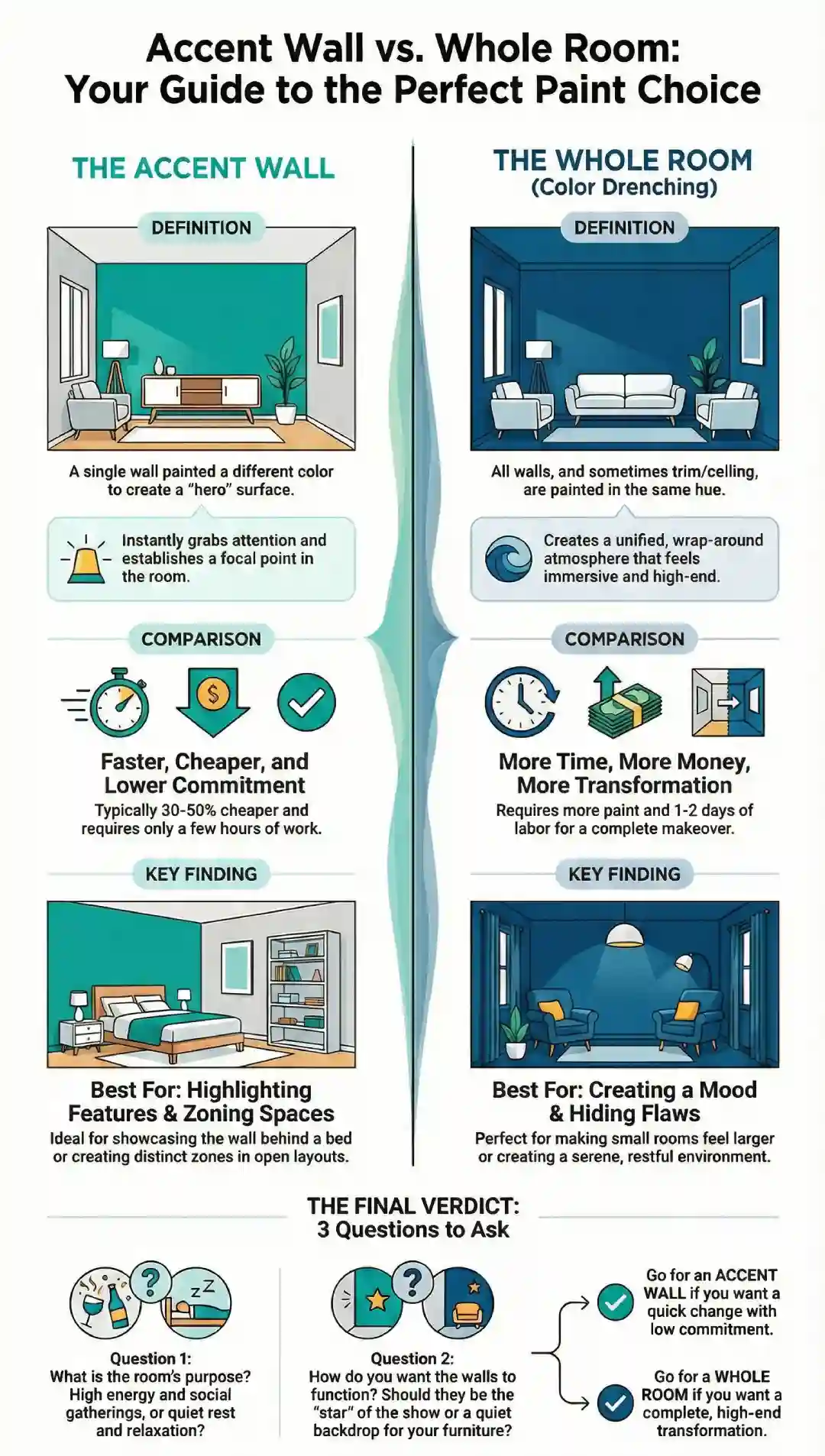
An accent wall is a single wall painted in a different color or texture from the other three. This technique is used to create a “hero” surface that immediately grabs attention. While, whole-room painting, which designers often call “color drenching,” involves painting every wall, and sometimes even the ceiling and trim, in the same hue. While an accent wall adds a burst of energy to a specific spot, color drenching creates an immersive, wrap-around atmosphere that feels unified. For Singaporean homes where space is at a premium, an accent wall can act as a visual anchor, while a full-room color can make a room feel more continuous and high-end. If you are planning a complete makeover,our renovation services can help with the heavy lifting.
Pros and Cons
Choosing between these two styles involves balancing your budget and your design goals. Below is a quick comparison to help you see how each method performs across key categories.
| Aspect | Accent Wall Pros | Accent Wall Cons | Whole-Room Paint Pros | Whole-Room Paint Cons |
| Visual Impact | Instant drama, hides flaws on one surface | Can overwhelm small spaces | Cohesive, spacious feel | Lacks focal points, feels flat |
| Cost & Effort | 30-50% cheaper, faster (2-3 hours) | Risk of mismatched colors | Uniform coverage hides imperfections | Higher paint volume, 1-2 days labor |
| Maintenance | Easy touch-ups on one area | Fading shows contrast sharply | Blends minor scuffs | Full repaint needed for changes |
| Resale Appeal | Trendy for millennials (2025 data) | Buyers may repaint | Neutral tones boost HDB value 5-10% | Dated colors hurt sales |
When to Choose an Accent Wall
An accent wall works best when you have a specific architectural feature you want to show off. This could be the wall behind your bed headboard or the area where your TV console sits. It is also a great way to test bold colors like charcoal or deep emerald without the commitment of painting the entire room. In open-concept HDB layouts, an accent wall is perfect for “zoning.” For example, painting a deep navy wall in your dining nook can help separate that area from the rest of the living room.
When to Paint the Whole Room
If your goal is to create a specific mood, painting the whole room is the better choice. Using a single color throughout a bedroom can create a sense of serenity and restfulness that an accent wall cannot match. This technique is also excellent for hiding flaws like irregular corners or exposed pipes, which are common in older resale flats. When the walls and the trim are the same color, the eye does not get distracted by harsh lines, making a small room feel much larger. If your current walls have cracks or uneven surfaces before you begin this transformation, you might need wall crack repair service to ensure a perfectly smooth finish.
Critical Decision Factors
Factor 1: The 60-30-10 Design Rule vs. Monochromatic Schemes
When deciding between an accent wall or a full-room color, it helps to understand the 60-30-10 rule. This classic interior design principle suggests that 60% of your room should be a dominant color (usually the walls), 30% a secondary color (upholstery or curtains), and 10% an accent color (pillows or art). If you choose an accent wall, you are essentially shifting part of that 60% into the 30% category to create contrast.
However, modern Singaporean homes are increasingly moving toward monochromatic or “tonal” schemes. In this approach, you paint the entire room in varying shades of the same color. This creates a sophisticated, seamless look that feels very intentional.
Factor 2: Lighting & Room Orientation
In Singapore, the direction your windows face is the most important factor in how paint looks on your walls. South-facing rooms receive consistent, warm sunlight throughout the day, which can make vibrant accent walls look even more intense. If you paint a whole room in a warm shade here, it might feel uncomfortably bright. Conversely, North-facing rooms get cooler, flatter light. In these spaces, a dark whole-room paint job can look muddy or black unless you have excellent artificial lighting.
Before committing to a color, we always suggest painting a small test patch and observing it in the morning and evening. Since lighting fixtures also change how color is perceived, you might want to consider our lighting installation to upgrade to LEDs that better complement your chosen palette.
Factor 3: Spatial Perception (Making a Room Feel Bigger or Cozier)
There is a long-standing myth that an accent wall automatically makes a room look bigger. In reality, it depends on the color and the wall you choose. A dark accent wall at the far end of a long, narrow room can actually make the space feel shorter because dark colors “advance” toward the eye. On the other hand, painting an entire room in a light, cool shade like soft grey or off-white can make the boundaries of the room seem to disappear, creating an airy feel.
If you have high ceilings in a landed property or a penthouse, painting the whole room in a deep, moody tone can make the space feel much cozier and more grounded. For homeowners in compact HDBs, we often recommend light whole-room colors to maximize the sense of space, which pairs well with mirror and shelves installation to further reflect light.
Factor 4: Trend Longevity and Resale Value
If you are thinking about selling your HDB or condo in the next few years, resale value should play a part in your decision. While bold accent walls are high-impact and personal, they can be polarizing for potential buyers. A buyer might see a bright orange wall and immediately think about the cost of repainting it. Whole-room neutrals like “greige,” sand, or ivory are generally the safest bet for maintaining a high resale appeal because they allow buyers to easily visualize their own furniture in the space.
However, subtle textures like lime wash or fluted panels are currently trending in Singapore for 2025 and can actually add a “luxury” feel that boosts property value. If you need to freshen up your home before a viewing, our room painting services can quickly return your space to a buyer-friendly neutral palette.
How to Pick the “Right” Wall for Your Accent
Finding the perfect wall for an accent is a strategic decision that relies on the natural flow of your home. In Singapore’s high-density apartments, where every square foot counts, picking the wrong wall can make a room feel disjointed or even smaller than it actually is.
The First Sight Rule
The most effective way to choose is the “First Sight Rule.” This involves standing at the entrance of your room and identifying the wall your eyes land on first. Usually, this is the wall directly opposite the doorway. By painting this surface, you create an immediate visual anchor that welcomes you into the space. In a living room, this is often the wall behind the sofa, while in a bedroom, the wall behind the headboard is the classic choice.
Symmetry and Interruptions
When selecting your canvas, look for a wall that is symmetrical and “clean.” You should avoid walls that are heavily interrupted by multiple doors, large windows, or air-conditioning units. These features “chop up” the color and prevent the accent from feeling like a solid, intentional statement. A large, unbroken wall allows the color to breathe and makes the room look more balanced. If your room is an awkward shape, which is common in older HDB flats, focus on the largest, most visible surface to provide the best impact.
Furniture Alignment
For a high-end, bespoke feel, your accent wall should align with your main furniture pieces. Connecting the wall color to your sofa, bedframe, or even a large piece of art helps the room feel “stitched together.” If your furniture is a neutral wood or grey, a deep teal or forest green accent wall can provide the perfect backdrop that makes the furniture pop. This alignment ensures the paint doesn’t look like a random choice but rather a planned part of your home’s story.
Trending 2025 Palettes for Singapore Homes
As we approach 2025, Singaporean homeowners are moving away from cold, sterile whites and embracing colors that provide a connection to nature and a sense of luxury.
Earthy Neutrals
The “Japandi” and Scandinavian-minimalist styles continue to dominate local interiors. The 2025 palette focuses on earthy neutrals like sage green, terracotta, and warm beige. These tones are popular because they mirror the lush greenery found across the island and provide a grounding energy that helps you relax after a long day at work. Sage green, in particular, is a favorite for home offices and bedrooms because it is proven to lower stress levels. These shades pair beautifully with rattan furniture and light oak flooring.
Moody Lux
For urban condos and those who want a “hotel-at-home” vibe, the “Moody Lux” trend is the go-to choice. This involves using deep, sophisticated shades like midnight blue, charcoal grey, and even eggplant purple. These colors add incredible depth to a room and act as a stunning backdrop for metallic accents like brass or gold. While some fear dark colors in small HDBs, when used as an accent wall with the right lighting installation, they actually make the boundaries of the room appear to recede, creating a sense of infinite space.
Textured Finishes
In 2025, paint is no longer just about color; it is about touch. We are seeing a massive surge in textured finishes like lime wash and the use of fluted wood panels as part of the paint strategy. Lime wash paint provides a mottled, stone-like appearance that adds old-world charm to modern flats. Similarly, painting fluted panels in a matte finish creates a play of light and shadow that a flat wall simply cannot provide. This trend is perfect for homeowners looking for something more unique than a standard paint job.
Common Mistakes to Avoid
Even with the best colors, a few simple oversights can make a professional-grade project look like a DIY disaster. Before you open the paint can, run through this checklist.
Ignoring the Ceiling and Trim
One of the most frequent mistakes is leaving the ceiling and trim in a standard “builder’s white” while the walls are a warm, rich tone. This creates a harsh, distracting line that breaks the immersion of the room. For a more polished look, consider painting the trim in a slightly lighter or darker version of your wall color. If you are painting the whole room, you might even try “color drenching,” where the ceiling matches the walls to eliminate visual clutter and make the room feel taller.
Choosing an Isolated Accent Color
An accent wall should never be a “lonely” color. If you pick a vibrant navy for one wall but have no other navy elements in the room, it will look out of place. To avoid this, ensure your accent color repeats elsewhere, perhaps in a throw pillow, a rug, or a piece of pottery. This creates a “visual thread” that pulls the room together.
Using High-Gloss on Imperfect Walls
While a glossy finish can look modern, it is also highly reflective. This means it will act like a spotlight on every minor bump, dent, or crack on your wall. In many Singapore homes, walls have slight imperfections from years of use or settling. For these surfaces, a matte or eggshell finish is much more forgiving as it absorbs light and hides flaws. If your walls have significant damage, it is essential to use a wall crack repair service before you start, ensuring your new accent looks as smooth as possible.
Frequently Asked Questions
Does an accent wall make a small room look smaller?
Not necessarily. If you use a receding color like cool blue or soft green, it can actually create the illusion of depth, making the room feel more spacious.
Should the accent wall be lighter or darker than the other walls?
Generally, an accent wall is painted in a darker or more vibrant shade to create contrast. However, a lighter accent wall can work if the other three walls are a medium tone and you want to brighten up a specific corner.
Can you have two accent walls in one room?
It is usually best to stick to one. Having two can make a room feel disjointed and cluttered, as the eye doesn’t know where to focus.
Which wall should NOT be an accent wall?
Avoid walls with too many “interruptions” like multiple doors, windows, or large wardrobes, as these break up the visual impact and make the room look busy.
Final Verdict: How to Decide in 3 Questions
To wrap up your decision-making process, ask yourself these three final questions. First, what is the main purpose of the room, is it for high-energy social gatherings or for rest? Second, how does the light hit the room at the time of day you use it most? Third, do you want the walls to be the “star” of the show, or do you want them to be a quiet backdrop for your furniture? If you want a quick change with low commitment, go for the accent wall. If you want a complete, high-end transformation that feels like a professional designer’s work, paint the whole room. No matter what you choose, our team at Handyman Services Singapore is ready to help you achieve a flawless finish. Contact us today for a reliable and affordable quote for your next home improvement project!